Guides
Used handyman equipment vs new: the cost comparison
New against used handyman equipment, decided by cost per working hour: the formula, the categories where used is wrong, and what to inspect before buying.
What to take away
- Used handyman equipment vs new is decided by cost per working hour: (P - S + Mx + Dt) / H, five inputs rather than one.
- Used wins where a tool is simple, serviceable, and slow to change: hammers, vises, ladders, racking.
- New wins where a battery platform, a safety function, or a warranty is doing the work.
- Fall protection, respirators, and electrical test gear should never be bought used. The reason is liability rather than value.
- Downtime is the hidden term. A cheaper tool that costs you a rescheduled job has already lost the comparison.
- Inspect against a written list, because a used tool is sold by somebody who knows what is wrong with it.
The comparison that matters
Define five numbers for a candidate tool, then run the formula twice, once for the new unit and once for the used one. Sticker price is one input.
Cost per working hour formula
- PPurchase price, made usable
- SResale value at end
- MxMaintenance, parts, service
- DtDowntime hours, valued cost
Symbol / Definition
- P
- Purchase price, including anything needed to make it usable
- S
- Realistic resale or residual value at the end of your holding period
- Mx
- Expected maintenance, parts, and service over that period
- H
- Working hours you will actually get from it before replacement
- Dt
- Expected downtime hours it causes, valued at what an idle slot costs you
Cost per working hour is (P - S + Mx + Dt) / H. Run it for both options and compare. Nothing else here matters as much as the fact that P is one of five terms.
A Milwaukee M18 Fuel 1/2 inch hammer drill kit with two 5.0 Ah batteries sells for about $399. A used bare tool on a dead battery platform often goes for $120 to $150.
Two replacement packs for that platform run $110 to $130 each, when they exist. On paper the used drill is cheaper. Divide by working hours and it usually is not.
H is usually shorter for a used tool, but not proportionally. A well-made tool bought at half its life may still deliver most of the hours you need before your business changes shape.
Dt is where used purchases quietly lose. A failure mid-job costs the rescheduled visit as well as the repair. At a typical $75 to $125 an hour, a lost half-day costs more than the tool.
Run a worked example on a framing nailer. New: $399, resale $150, $80 maintenance, 1,200 hours, and four downtime hours at $100 an hour. That is about 61 cents a working hour. Used: $180, no resale, $200 maintenance, 700 hours, and 16 downtime hours. That is about $2.83. Swap in your own rates.
Used usually wins on simple, serviceable tools, and new wins on battery, safety, and warranty items.
Every price here is a typical US street price, not a quote, so check current retail before you buy. Canadian buyers should run the same formula on local prices for the same models.
Where used handyman equipment wins
Hand tools are the clearest case. An Estwing 16 ounce rip hammer sells new for about $35, a Channellock 420 plier for about $20, and a 25 foot Stanley FatMax tape for about $25. Secondhand versions of all three cost half as much and last decades.
Bench and site equipment with a stable design belongs here too. A 6 inch bench vise from Wilton or Yost runs $150 to $300 new and $60 to $120 used. A vise has almost nothing on it to wear out.
Access equipment qualifies when it passes inspection. A 6 foot Werner or Louisville fiberglass step ladder costs $150 to $250 new, and used ones turn up at $80 to $120.
The common thread is serviceability. A tool that can be repaired locally has a long H and a modest Mx, and that combination is what makes a used purchase pay.
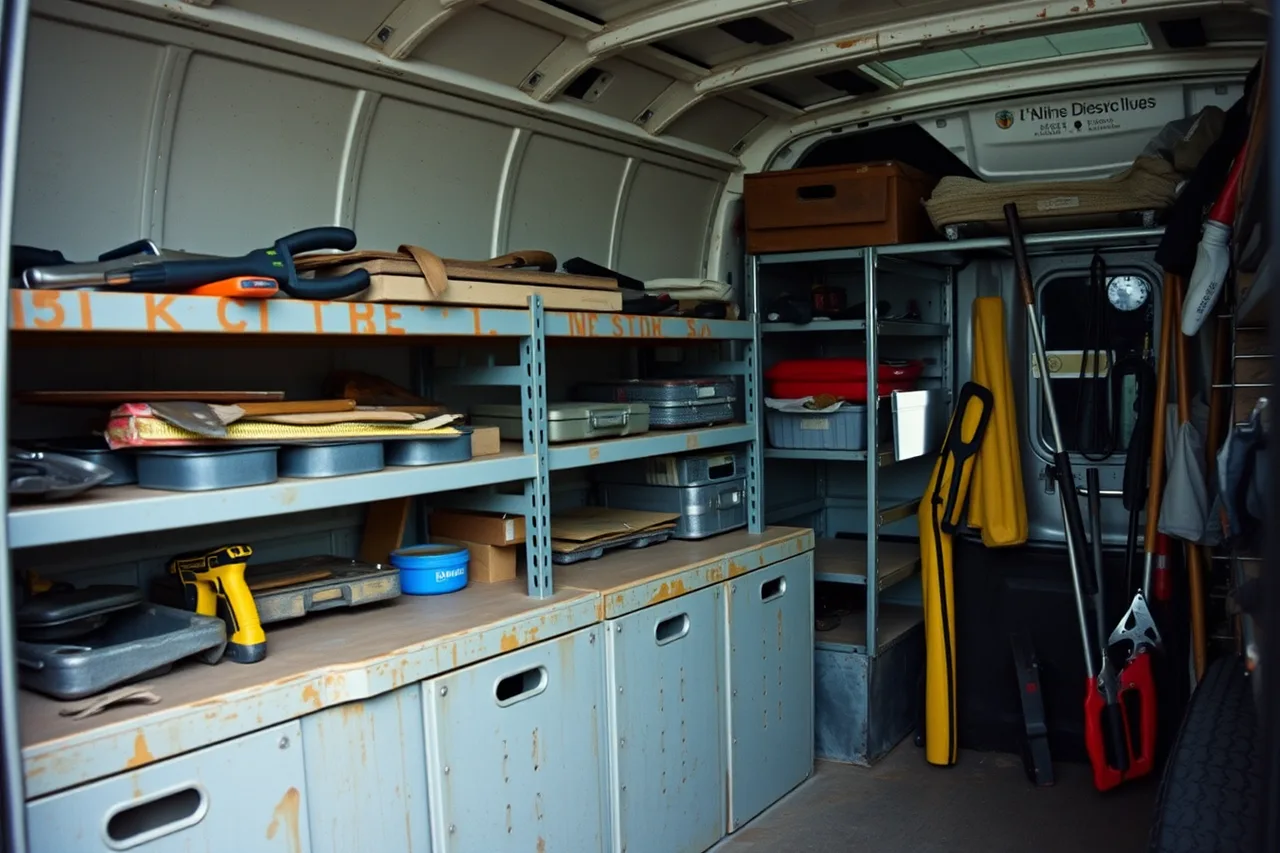
Storage and organization equipment is the underrated case. Racking, cases, and shelving are almost never worth buying new. A DeWalt ToughSystem 2.0 rolling toolbox runs about $199, and a Milwaukee Packout three-piece stack runs $250 to $300. Used units from a closing van often sell at half.
Owners defer them because tools seem a better use of money. Buying used organizes the van early, worth more than most individual tools. The reasoning is in the van and kit setup.
Where new handyman equipment wins
Battery tools, because the platform and the packs are the actual purchase. A used tool on a discontinued platform is a tool you cannot get batteries for, and battery condition is close to unverifiable at the point of sale.
Count the platform, not the tool. A Milwaukee M18 5.0 Ah pack runs about $120, a DeWalt 20V MAX 5.0 Ah pack about $100 to $130, and a Makita 18V LXT 5.0 Ah pack about $110. Three packs cost more than the bare drill they feed.
Used versus new by category
Used wins
- Tool type
- Hand tools, racking
- Safety function
- Not applicable
- Warranty
- Not relied on
- Design change
- Unchanged decade
- Serviceability
- Local repair, long H
New wins
- Tool type
- Battery tools
- Safety function
- Guards, brakes, cut-off
- Warranty
- Relied on
- Design change
- Dust, detection moved
- Serviceability
- Discontinued platform
Anything whose safety function is the point: guards, brakes, detection, and cut-off behavior. You cannot inspect what a previous owner defeated and put back.
Anything under a warranty you will actually rely on. If the tool being unavailable stops the business, the warranty is buying you Dt reduction rather than repair cost.
And anything where the design has genuinely moved. Dust control and detection are the two categories where a decade-old tool is doing a materially worse job, and the difference shows up in a customer's home rather than in your accounts.
A Festool CT 26 HEPA dust extractor lists at about $700, and current Bosch or Makita HEPA extractors run $400 to $600. OSHA's silica table for construction is why that spend is not optional.
The categories to buy new regardless
Some equipment should not be bought used, and the reason is exposure rather than economics.

Fall protection and anything that arrests a fall. It has a history you cannot see, and that history is exactly what decides whether it works.
A 3M DBI-SALA or Miller harness runs $150 to $350 new; a used one is a $50 gamble. OSHA's fall protection guidance for residential construction sets out what the work requires, and buying the equipment secondhand undermines the whole arrangement.
Respiratory protection and anything with a filter or a seal. A 3M 6000 series half mask runs about $35 with cartridges. Personal protective equipment generally, in fact, because it is fitted to a person and its condition is not visible.
Electrical test equipment, where an out-of-calibration reading is worse than no reading at all. A Fluke 117 multimeter costs about $200 new and $120 used, and a Klein Tools MM700 about $100. A calibration certificate is worth more than the saving.
This is not a value judgment. It is that these items belong in a standing safety program, in the sense OSHA describes in its recommended practices for a safety and health program, and a program cannot be built on equipment whose condition is unknown.
Inspecting a used tool
Work from a written list, in this order, and stop at the first failure.
Used tool inspection order
- Power up cold and listen
- Run under load, not free
- Check chucks, guards, cords, switches
- Ask what parts are available locally
- Inspect case and accessories
- Ask why it is being sold
- Cord and plug. Check the sheath for cracks, the strain relief for movement, and the ground pin for bending, then flex the cable along its length.
- Bearings. Spin the spindle by hand and listen for rattle or grinding, then check for side play.
- Brushes. On a corded motor, ask for the brush caps to be opened, since short or chipped carbon points to a worn commutator.
- Guards. Confirm the guard is present, returns freely, and has not been cut, pinned, or removed.
- Calibration. For any measuring or test instrument, ask for a certificate dated inside the interval the maker sets.
- Serial number and warranty. Match the serial plate to the listing, then ask whether the maker will transfer any remaining cover.
Buy from a business rather than an individual where the difference in price is small, because a business leaves you somewhere to return to.
Recording the decision
Attach the record to the tool: what it cost, when, and the warranty, since equipment is not a consumable in your books and the IRS sets out what kind of records to keep.
Whoever takes the tool next inherits its quirks, which makes the handover part of how people are hired and trained.
Common questions
Is a used van a different decision from used tools?
Bigger, because the vehicle carries the business rather than sitting in it. The formula still applies, and Dt dominates: a van off the road stops every job, not one.
Budget for it as a cost per working hour too. A used Ford Transit Connect typically runs $14,000 to $18,000, a new compact cargo van $32,000 or more. The used one wins only if it stays on the road, so have any van inspected by somebody who owes you nothing.
How do I value my own downtime?
At what an unfilled slot would have contributed, not at the repair bill. That is the number to use for Dt.
Should a growing business standardize on new?
On platform, yes. On individual tools, no. Two technicians who cannot swap batteries is a routing problem, and the kit consequences of adding a route are in the opening equipment checklist.
Can buying used ever create a compliance problem?
It can, where the equipment relates to work you may not perform anyway. Owning a tool is not permission to use it.
The boundary is set by your state and your local building department, as where the licensing line sits explains. Buying cheaply into a category you should be referring out is the worst of both outcomes.
What about buying a competitor's whole kit when they close?
Attractive, and rarely as good as it looks. You inherit their service mix and platform choices. Parts you would not have bought still take van space.
Price the items you want. Store or sell the rest. The routing and marketing implications of taking on their customer list are separate, covered in how the work is won.