Guides
Handyman startup planning: buckets, buffer and funding
Handyman startup costs: split one-time and monthly outlays, size a cash buffer by formula, and weigh funding routes, including SBA microloan terms.
What to take away
- Handyman startup planning starts with two different cost questions wearing one name. What you buy once and what you have to keep funding behave nothing alike.
- The number that sinks new handyman businesses is not the kit. It is the gap between finishing work and being paid for it.
- Size the opening buffer from a formula you can defend, then test it against your own worst assumption rather than your best one.
- Every funding source has a price. Some charge interest, some charge control, and one charges your relationship with the person who lent it.
- Four costs are left out of almost every first estimate. They are listed below so yours includes them.
Two buckets that behave differently
Write your costs into two columns and never merge them.
One-Time vs Recurring Costs
One-Time Outlay
- Van or conversion
- Yes
- Initial kit
- Yes
- Registration and license
- Yes
- Insurance deposits
- Yes
- Insurance premiums
- No
- Phone and software
- No
- Fuel and vehicle
- No
- Owner draw
- No
Recurring Outgoing
- Van or conversion
- No
- Initial kit
- No
- Registration and license
- No
- Insurance deposits
- No
- Insurance premiums
- Yes
- Phone and software
- Yes
- Fuel and vehicle
- Yes
- Owner draw
- Yes
The first column is one-time outlay: the van or its conversion, the kit that must be there before the first job, registration and license fees, and initial insurance deposits. Add signage and the tools you cannot borrow.
Work out what the van has to carry before you price this column. The list drives the number, not the other way around.
Whether license fees belong in this column at all is a state question, and the answer changes the size of the work you can take. In California, for example, anyone who alters a structure must be licensed by the Contractors State License Board if the project requires a building permit, uses any additional workers, or the total cost of labor and materials is $1,000 or more, and work on a larger project may not be broken into smaller contracts to stay under that line. Check your own state's contractor licensing board before you price column one, because hiring your first helper can move you into licensing.
The second column is recurring outgoing: insurance, phone, software, fuel, vehicle payment or maintenance, storage, and whatever you personally need to live on. This column runs whether or not the phone rings.
Keep them apart. The first column is a problem you solve once. The second is a problem you solve every month until revenue does it for you.
Lenders and your own plan treat them differently. So should you. The Small Business Administration's guide to calculating startup costs organizes the same split: one-time expenses such as major equipment and permits, licenses and fees, and monthly expenses, of which it says to count at least one year, with five years ideal. It also suggests adding a little extra, say 10%, to cover miscellaneous expenses you cannot predict.
Sizing the opening buffer
Use letters, not other people's numbers. Yours are the only ones that mean anything.
Opening Buffer Formula
- KOne-time setup outlay
- MMonthly fixed outgoings
- DMonthly owner draw
- TMonths until revenue covers M+D
- CCollection lag in months
- B = (M + D) x (T + C)Opening buffer
- K + BTotal needed before start
Symbol / What it is
- K
- One-time setup outlay · Your own kit and registration list, priced from real quotes
- M
- Monthly fixed outgoings · Your insurance, phone, vehicle, software and storage bills
- D
- Monthly owner draw · What you actually need to live on, not what you hope to earn
- T
- Months until collected revenue covers M plus D · Your own estimate, then the same estimate doubled
- C
- Collection lag in months · Time from finishing a job to the money arriving
The opening buffer is then:
B = (M + D) x (T + C)
And the total you need before you start is K + B.
Two things about that formula matter more than its shape. First, C is real and usually underestimated. A handyman who invoices on completion and gets paid in thirty days funds a month of someone else's home improvement out of pocket, every month, permanently.
Deposits and card payment at the door shrink C. Shrinking C cuts the money you need to raise more reliably than cutting the kit does.
Second, T is the number owners get wrong, and they err in one direction. Run the formula with your T estimate, then again with T doubled.
A worked example in months shows how much that test moves. Say you expect collected revenue to cover M plus D after four months, and customers pay one month after the job: T + C is 5, so B is five months of M plus D. Double T to eight and B becomes nine months of M plus D, almost twice the buffer, from one honest change of assumption. Cut C to zero with payment at the door and the doubled case falls back to eight months.
If the second answer is not survivable, you will not start with less money. You will keep another income while the business finds its footing.
Funding sources and their tradeoffs
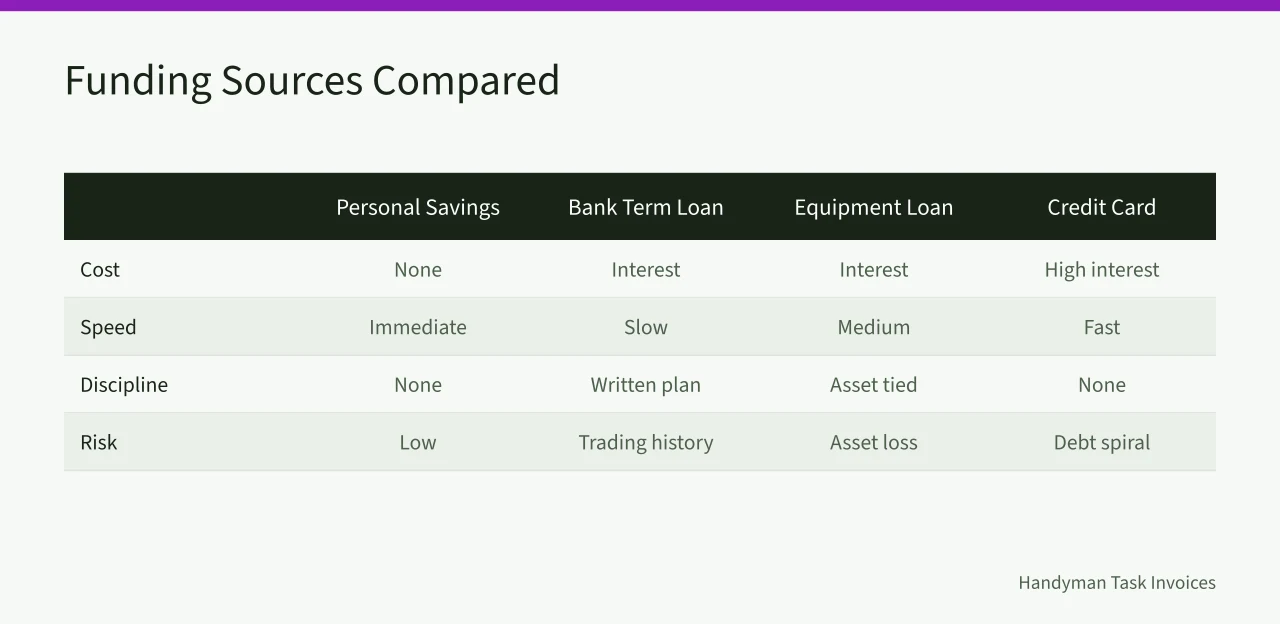
- Personal savings. No interest, no covenant, and no external discipline. The hidden cost is that there is nobody to say no to a purchase that is not yet necessary.
- A bank or credit union term loan. Predictable, and it forces a written plan, which is a benefit disguised as a chore. Usually wants trading history a new business does not have.
- An equipment loan or lease tied to the van. The asset secures the debt, so it is often available earlier. It also means the vehicle is not fully yours if the business stalls.
- A credit card or revolving line. Fast and expensive. Defensible for smoothing C, the collection lag, and hard to justify for buying column one.
- An SBA microloan. SBA microloans run up to $50,000 through SBA-approved intermediary lenders, and the average microloan is about $13,000. They can pay for working capital, supplies and equipment, but not existing debts or real estate. The intermediary, not the SBA, makes the credit decision and sets the terms: interest rates vary by lender and generally sit between 8% and 13%, and the maximum repayment term is seven years.
- Family. Cheapest on paper and the only source that charges you a relationship if the business struggles. If you use it, write terms as if it were a bank.
- Customer deposits. Not funding, though owners treat it as such. Money taken for materials on a job you have not started is spoken for, and spending it on last month's fuel is how a small business quietly becomes insolvent.
Whatever you choose, the tax treatment of what you borrow, buy, and depreciate is decided by the structure you register, which the IRS lays out for anyone starting a business.
The four costs left out of almost every first estimate
- Downtime with a full kit. The van is paid for, insured, and parked. Column two runs anyway. Most first estimates model a busy month and none model a quiet one.
- Consumable restock. Fasteners, sealant, blades, and abrasives leave the van a little at a time and are almost never captured, because no single purchase is large enough to notice.
- Rework. The second visit to fix something you did is unbilled, and it consumes a slot that a paying job wanted. Budget for it existing rather than assuming it will not.
- The safety spend that has no invoice attached. A better ladder, the right eye protection, the fall arrest gear for the one job a year that needs it. OSHA's recommended practices for a safety and health program treat this as an ongoing program rather than a purchase, which is the right way to budget it too.
None of these belong in a founding fantasy. All of them appear in month three.
Four Overlooked Costs
- Downtime with a full kit
- Consumable restock
- Rework
- Safety spend with no invoice
Common questions
Can I start with borrowed tools?
For a while, and it is a reasonable way to keep column one small. The limit is reliability: a borrowed tool is unavailable on the morning it matters, and a job rescheduled for want of a drill costs more than the drill. Borrow to test whether you need something, then buy the ones you reached for repeatedly.
Should the kit be bought before or after the first customers?
After, wherever the work will wait a few days. Buy the tools that the jobs you actually booked demanded, not the ones a general list suggested. This is also why the earliest jobs are worth logging in detail: the log tells you which tools earned a place in the van.
Does the funding decision change what I should sell?
It should. Debt with a fixed monthly payment pushes you toward work with a predictable schedule, which is one argument for the recurring shapes in the package shortlist. Savings-funded businesses can afford to be choosier for longer.
How do I present these numbers to a lender?
As two columns, a formula, and a stated assumption for T and C, with the sensitivity run alongside. A plan that shows what happens when the assumption is wrong reads as competence. For an SBA microloan, that document goes to the intermediary lender, which sets the terms, and the local demand evidence behind it belongs in the market reading.