
Guides
How to Calculate Handyman Lead Costs per Won Job
Learn how to calculate handyman lead costs per won job from channel spend and collected jobs, then test the result against gross profit using a worked example.
What to take away
- Paid lead marketplaces bill per lead or by subscription, so the real cost per job depends on how many of those leads you close.
- A referral fee is a slice of the finished invoice, which costs more on large jobs and nothing on jobs you never win.
- A channel pays for itself only when gross profit, after labor, materials and drive time, still covers the fee.
- Measure cost per won job instead of cost per lead, because leads you lose still cost money.
- Word of mouth is the cheapest per job and the hardest to increase on demand.
How handyman lead costs are priced
Lead generation for handymen comes in four shapes, and each one moves your numbers differently. Shared marketplaces sell the same lead to more than one pro, so you pay before you know whether you win.
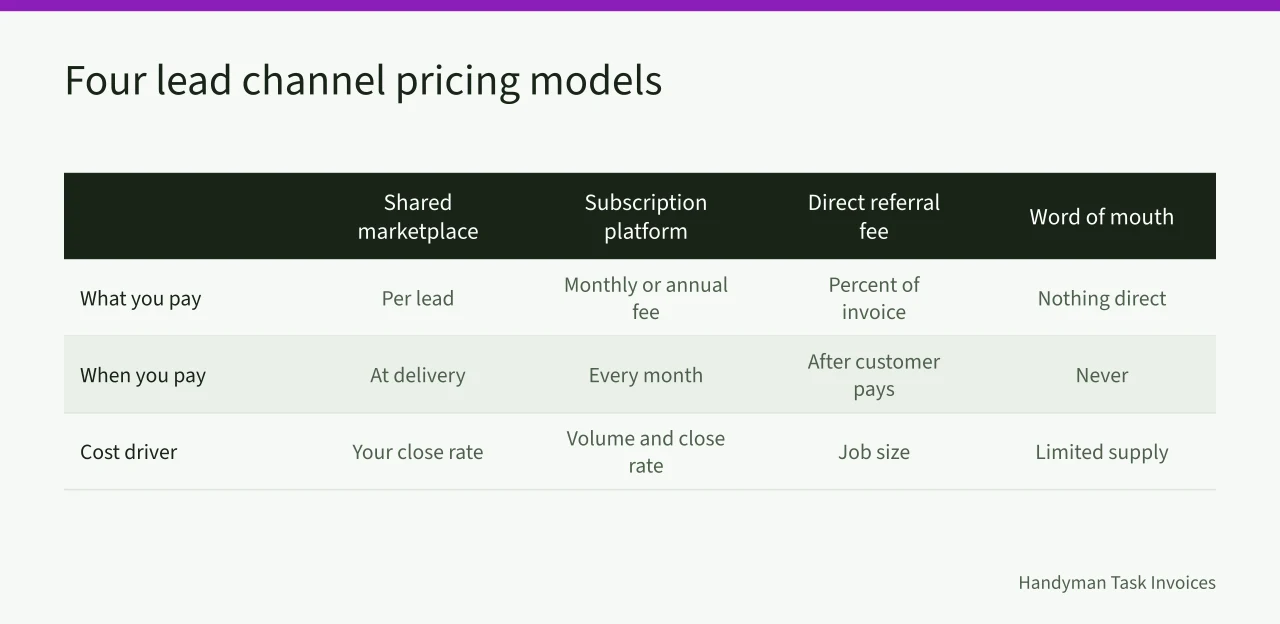
Subscription platforms charge on a schedule whether or not the phone rings. Referral fees are paid after the work is done, usually as a percentage of the invoice. Word of mouth costs nothing and arrives on its own timetable.
How lead costs are priced
What you pay
- Shared lead marketplace
- Per lead, often resold to several pros
- Subscription platform
- Monthly or annual fee
- Direct referral fee
- Percentage of the invoice
- Word of mouth
- Nothing direct
When you pay
- Shared lead marketplace
- At delivery, won or lost
- Subscription platform
- Every month
- Direct referral fee
- After the customer pays
- Word of mouth
- Never
What moves your cost per won job
- Shared lead marketplace
- Your close rate
- Subscription platform
- Lead volume and close rate
- Direct referral fee
- Job size
- Word of mouth
- Nothing, but supply is limited
The pricing model matters more than the headline number. A cheap lead you rarely close can cost more per won job than an expensive lead you usually close. That is arithmetic, not opinion. The Schedule C guide covers U.S. reporting of business income and expenses; Form 1099-NEC reports nonemployee compensation, not marketplace prices.
What a job must earn before a lead fee pays for itself
Start with the invoice, then subtract everything the job consumed. Materials, permit fees, helper pay, vehicle costs, and the hours you could have spent earning elsewhere come out first. What remains is gross profit, and the lead fee or referral percentage is paid from that remainder.
A lead fee is not a marketing expense you absorb forever. It is a cost of the job, and it competes with your own hourly pay.
This is where owners get caught. A ten percent referral fee on a small repair can equal an hour of labor. The same percentage on a larger job may come out below what a per lead charge would have cost.
Whether those costs reduce taxable income is a separate question. Advertising and lead costs are ordinary business expenses, and IRS Publication 535 sets out the rules on what a trade or business may deduct.
Referral fees and word of mouth side by side
Referral fees scale with the job, and that is the whole trade. On a large job the fee is real money. On a job you never win the fee is zero.
Paid leads invert that. You pay first, and the risk of losing sits with you. Large directories in the Angi and Thumbtack mold sell leads or recurring placements instead of taking a share of the invoice.
Word of mouth behaves like a referral fee of zero percent. It is still not free. You earn it by finishing on time, cleaning up, and asking for the next job. The cost shows up as slower growth rather than an invoice.
To compare channels, use the same job's gross profit and calculate what each source costs per won job.
Example: two channels on one job
Suppose a job invoices at $1,200. Materials take $300, two days of your own labor are worth $600 to you, and fuel and tolls add $40. Gross profit is $260.
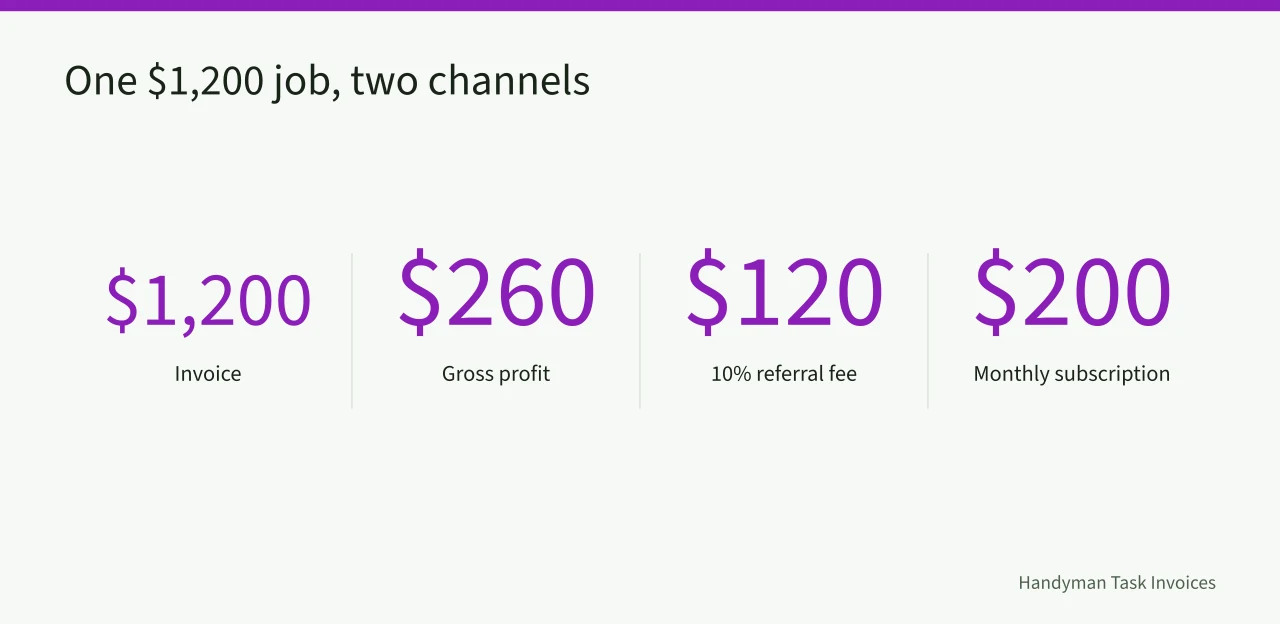
A ten percent referral fee on that job is $120, which eats nearly half the profit. A $200 monthly subscription needs this same job roughly once a month just to break even.
Change any input and the ranking can flip. A larger job makes the subscription look cheap. A smaller job makes the percentage fee look cheap. Run your own figures before you commit to a channel.
Tracking your handyman marketing cost per job
Tracking cost per job
- Tag every lead with its source the moment it arrives.
- Add up what that source cost during the month, including fees and subscriptions.
- Count how many of those leads became paid jobs, not how many became estimates.
- Divide the source cost by won jobs to get cost per won job.
- Subtract that number from gross profit to see which channel clears.
That figure is your customer acquisition cost for the channel. Keep the source tag with the invoice record so the numbers survive tax time. The IRS recordkeeping guidance explains what to keep and for how long.
Billing and collection also shape the math. Late payments tie up cash that a referral fee does not touch, and the SBA guidance on managing your finances covers invoicing and collection practices.