Guides
Handyman invoice records retention: how long to keep task paperwork
How long US and Canadian handymen must keep task invoices, receipts and job files, covering IRS and CRA periods, state sales tax clocks and digital storage.
What to take away
- The IRS generally expects records supporting a filed return to be kept for three years, and four years for employment tax records when you pay helpers.
- The CRA asks Canadian handymen to hold income and GST/HST records for six years from the end of the tax year they relate to.
- State sales tax agencies run their own clocks, usually three to four years, so a four year floor beats matching the federal minimum.
- A complete task file holds the invoice, change orders, photos, receipts, mileage logs and proof of payment, not the invoice copy alone.
The IRS retention baseline for handyman task paperwork
Federal recordkeeping guidance gives a default of three years from the date you file a return, or two years from the date you pay the tax, whichever is later.
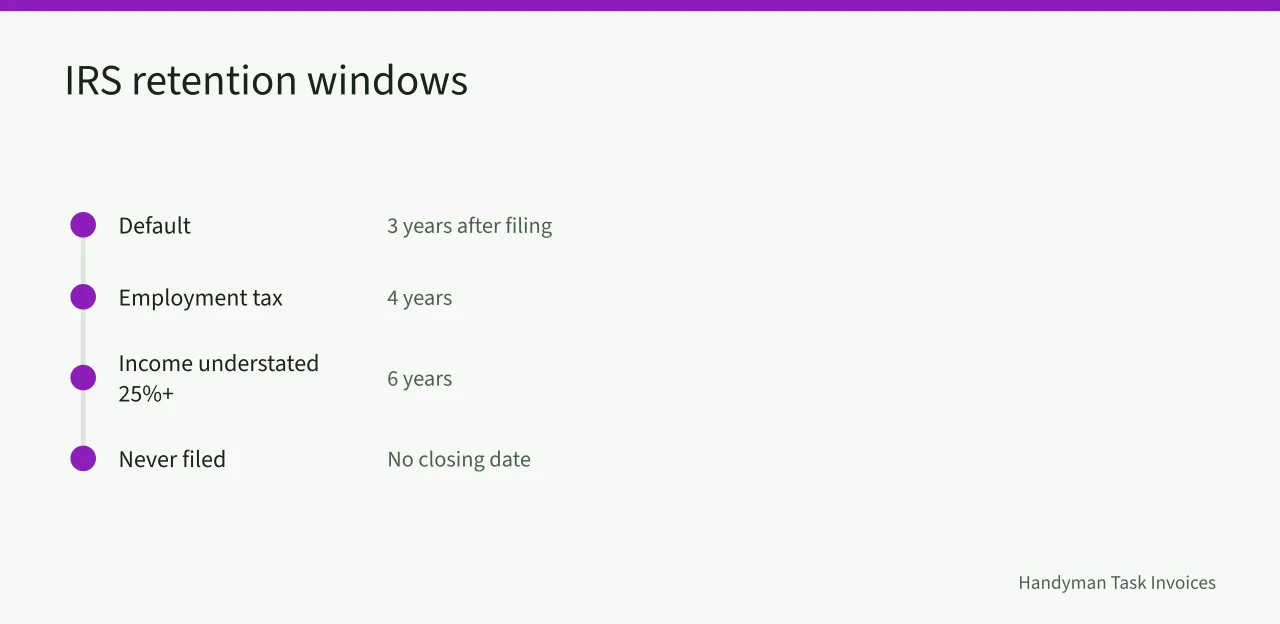
Two situations stretch that window. Employment tax records run four years after the tax is due or paid. If gross income is understated by more than 25 percent, the assessment window becomes six years, and a return never filed has no closing date.
Which name goes on the invoice depends on whether you bill as a sole proprietor or work under a homeowner's direction. Settle your handyman task invoice numbering before the first job, because sequential numbers are the spine of any audit trail.
Records for property such as a truck or a compressor stay longer. Keep them for the ownership period plus three years after disposal, since depreciation questions can arrive long after the job that paid for the tool.
State sales tax clocks and the four year habit
Most states do not follow the federal three year figure for sales tax. Florida generally requires dealers to keep sales tax records for three years, and California's tax department generally expects four years.
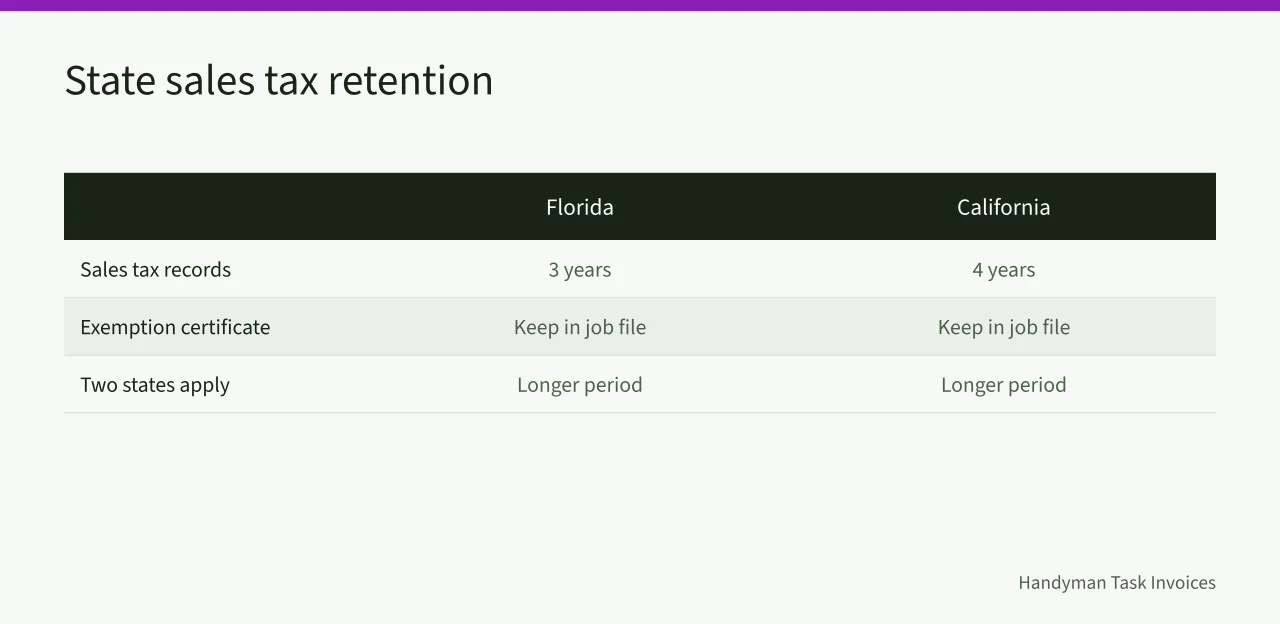
If you buy materials tax free using a resale or exemption certificate, that certificate belongs in the job file. Auditors ask for it years later, often when the supplier is audited rather than you.
The wider question of how long to keep handyman invoices has a different answer for each state you touch. Where two states apply, keep records for the longer period.
Canada: six years for GST/HST and income records
Handyman bookkeeping records in Canada carry a six year clock. The CRA measures it from the end of the last tax year the records relate to, and it covers income tax and GST/HST files. Records stay in Canada unless written permission says otherwise.
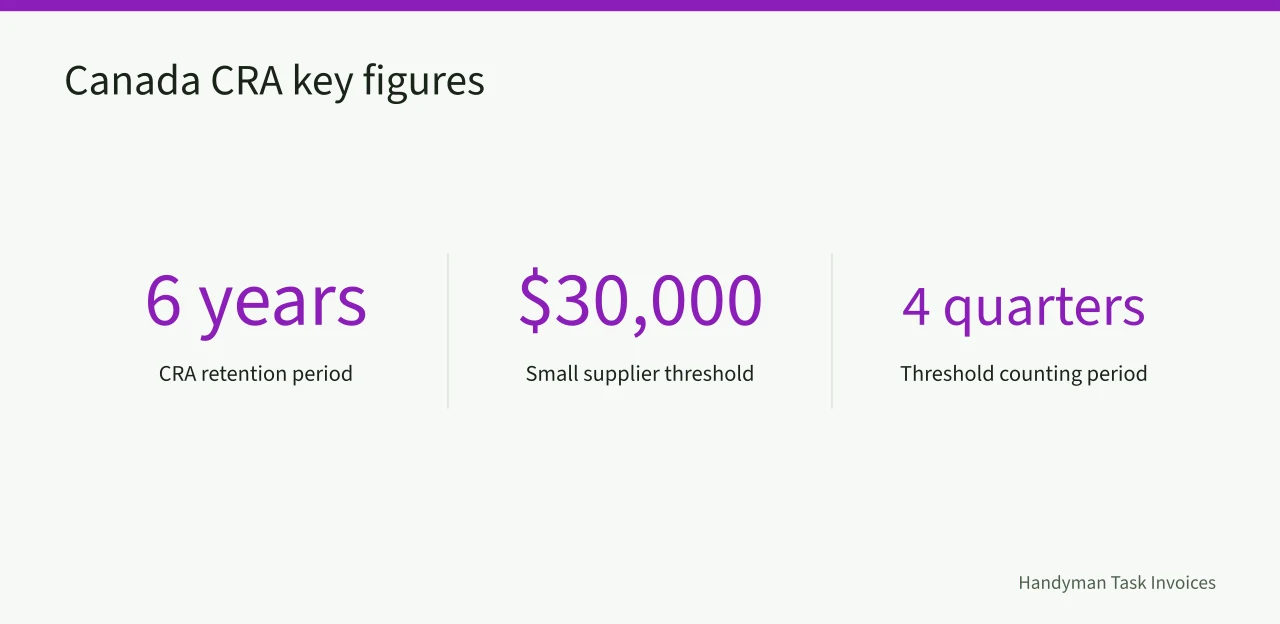
Registration is the trigger most contractors ask about. A small supplier stays under the $30,000 threshold counted over four consecutive calendar quarters, and above that you charge and remit tax. The CRA explains when small contractors must charge HST.
A Canadian task invoice is a tax document first, which makes it a useful model for US audit trails. See what US handymen can learn from Canadian GST/HST task invoicing before copying the format.
Small business invoice retention schedule by record type
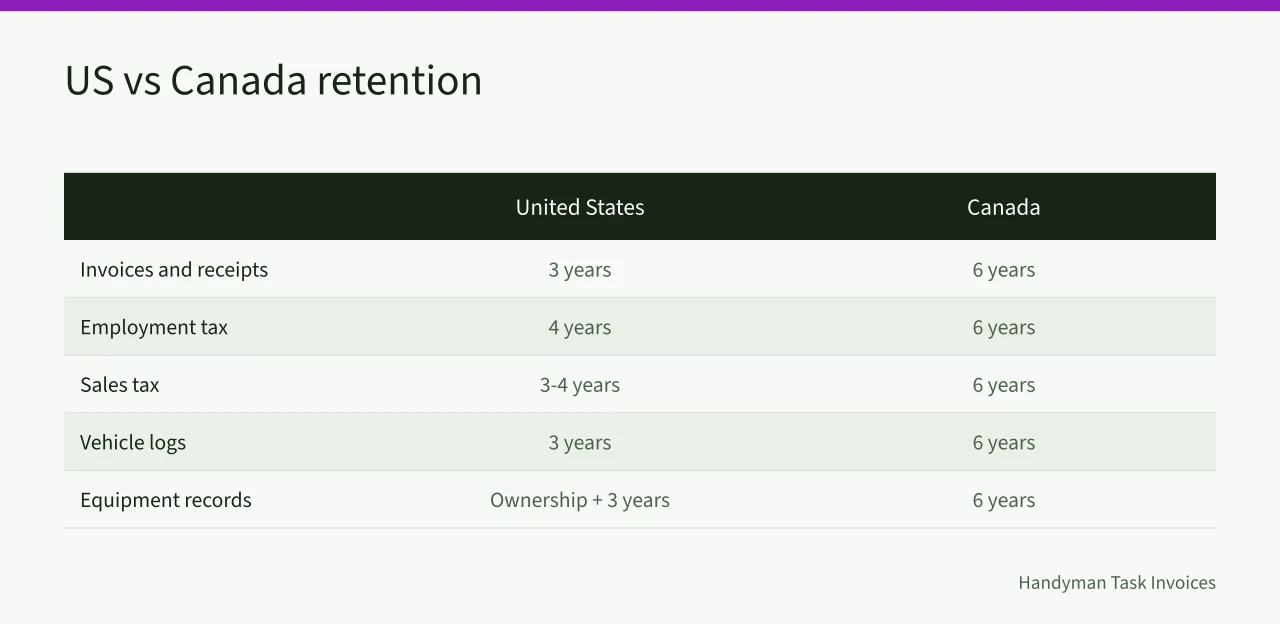
Small business invoice retention schedule
| Record type | United States | Canada |
|---|---|---|
| Task invoices, receipts and deposits | 3 years after filing | 6 years |
| Employment tax records | 4 years | 6 years |
| Sales tax returns and exemption certificates | 3 to 4 years by state | 6 years for GST/HST |
| Vehicle and mileage logs | 3 years, or until the vehicle claim closes | 6 years |
| Equipment and property records | Ownership period plus 3 years | 6 years after disposal |
What a complete job file holds
- Invoice copy with number, date, labor hours, materials and tax lines
- Signed change orders for added work
- Before and after photos tied to the invoice date
- Material receipts and exemption certificates
- Mileage log covering the trip to the job
- Payment record, such as a check image or bank deposit line
A handyman task invoice template that prompts for all six items closes the gap, because the file is complete before the truck leaves the driveway.
Example: the file that answered a sales tax letter
A Colorado handyman replaced hail damaged gutters in June and billed with a photo set and two material receipts. Fourteen months later the state asked for proof the materials were installed rather than resold.
The invoice, the supplier certificate and the dated photos answered the question in one reply. Storm season raises the same issue every year, so read about pricing hurricane and hail tasks in Florida and Colorado.
Digital storage and retention steps
Scanned invoices hold up when they are legible and can be reproduced, which is the standard the IRS applies to electronic records. Cloud folders work, but a backup outside the same account protects you if a subscription lapses.
- Name every file with the invoice number and job date, for example 1042-2024-06-14.
- Scan receipts the day materials are bought and attach them to the job folder.
- Keep a separate folder for tax returns, sales tax filings, exemption certificates and insurance policies.
- Set a January reminder to delete only records past the longest period that applies to your states and your province.
The SBA offers guidance on managing finances as a small business, including invoicing and collection, which is the same work that produces the records you are holding.
If you carry workers compensation or liability coverage, keep policy and payroll records past the final premium audit. Claims can arrive after the policy year ends.