
Guides
What to measure every month in a handyman business
Handyman KPIs for a monthly review: six measures with their formulas, the decision each one changes, and what every single one of them hides.
What to take away
- Six measures are enough. Each has a formula, a decision it changes, and a blind spot you have to hold in mind while reading it.
- A measure with no decision attached is a number you will look at and do nothing about. Drop it.
- Read them together. Every one of these can be improved in a way that damages another, and reading one alone is how that happens.
- Set your own reference point from your own history. Any figure quoted from elsewhere describes a different business.
- Look monthly, act on a trend, and never on a single month.
The six
Booked jobs per week against break-even
Formula: jobs completed in the period, divided by weeks, compared against the break-even count from your own fixed costs and contribution.
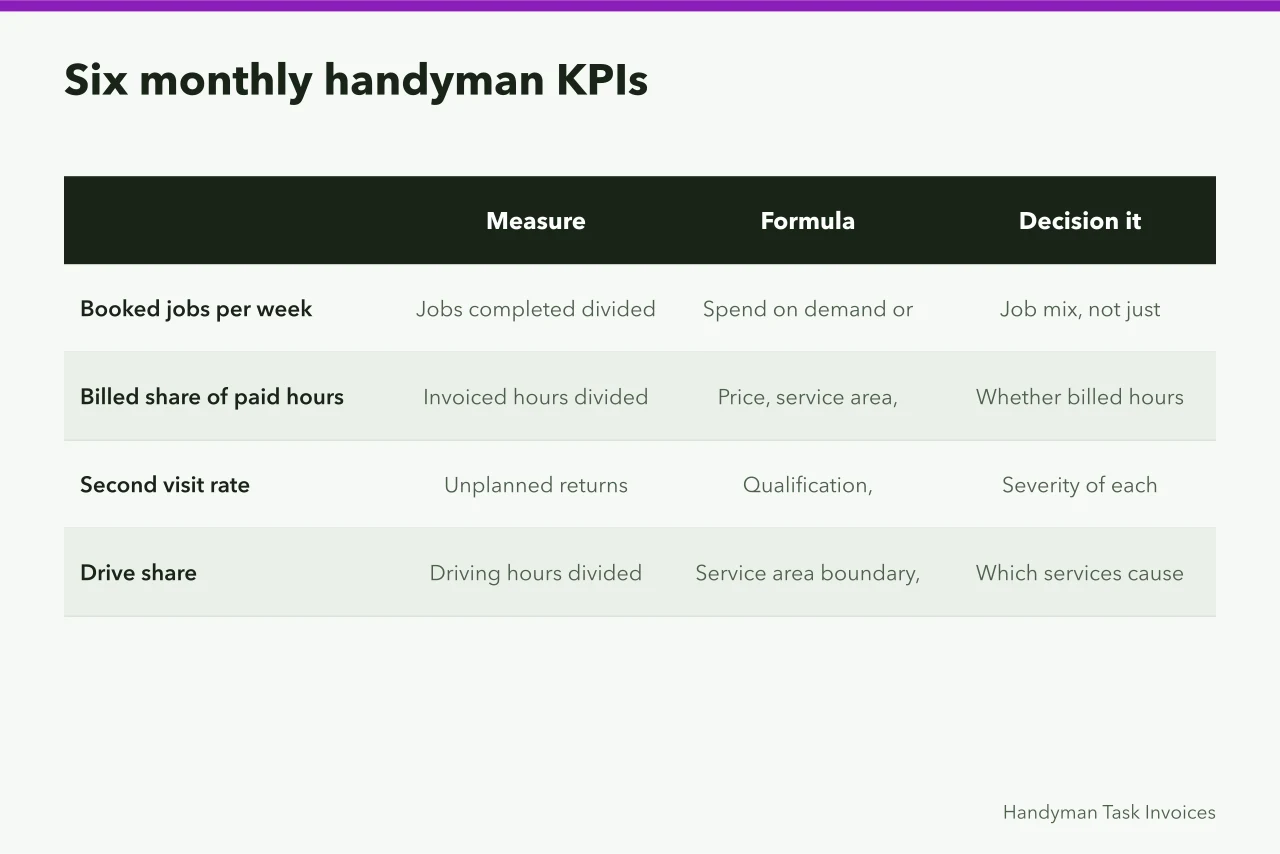
Decision it changes: whether to spend on demand, tighten costs, or do neither.
What it hides: the mix. A week of small clustered jobs and a week of large scattered ones are not the same week, even at the same count.
Billed share of paid hours
Formula: hours that reached an invoice, divided by all hours paid for, including travel, quoting, restocking, and admin.
Decision it changes: the price, the service area, or the stocking, depending on where the unbilled time is going.
What it hides: whether the billed hours were priced properly. A high share at the wrong rate is still a loss, since this ratio sets the rate rather than replacing it.
Second visit rate
Formula: unplanned return visits, divided by jobs completed.
Decision it changes: qualification questions, stocking, or training, and the rework log tells you which.
What it hides: severity. One return that cost a day and five that cost twenty minutes look identical here, so keep the reason alongside the count.
Drive share
Formula: driving hours, divided by paid hours.
Decision it changes: the service area boundary, the day the far jobs are grouped onto, and which services are offered where.
What it hides: whether the driving was avoidable. A supplier trip and a long customer drive are both in this number and have completely different fixes, so split them, and treat supplier trips as a stocking finding against the opening equipment checklist rather than a routing one.
Days from completion to payment
Formula: the average number of days between a job being finished and the money arriving.
Decision it changes: deposits, payment at the door, invoicing speed, and how much working capital the business needs.
What it hides: the outliers. One customer at ninety days can hide inside an acceptable average, so look at the longest as well as the mean.
Enquiries by source that became bookings
Formula: bookings from a source, divided by enquiries from that source, tracked per source.
Decision it changes: where marketing time and money go, and whether the problem is demand or conversion.
What it hides: quality of work won. A source with excellent conversion that sends you jobs you should refuse is costing you, so read it beside the count of enquiries you declined.
Reading them together
Each of these can be improved in a way that damages another, and that is the real reason to review them as a set.
KPI trade-offs to watch
- Drive share improves if you refuse distant work
- Booked jobs per week may fall as a result
- Billed share improves if you stop free quote visits
- Enquiry conversion may fall with it
- Second visit rate improves if technicians take longer
- Billed hours per day fall while they do
- Drive share improves if you refuse distant work, and booked jobs per week may fall as a result.
- Billed share improves if you stop giving free quote visits, and enquiry conversion may fall with it.
- Second visit rate improves if technicians take longer on site, and billed hours per day fall while they do.
The point is not to optimize any one of them. It is to notice which trade you are making, deliberately, this quarter.
Setting a reference point
Do not import a benchmark. Any figure published for this trade describes a business with a different mix, a different geography, and a different definition of the terms.
Set your own reference point
- Do not import a published benchmark
- Take three months of your own history
- Compute all six measures
- Write them down as your starting position
- Watch the direction month to month
- Two consecutive wrong-way months is a signal
Instead, take three months of your own history, compute all six, and write them down as your starting position. Then watch the direction. A measure moving the wrong way for two consecutive months is a signal; a single month is weather, holidays, or one unusual job.
Making the numbers exist
None of this works without fields captured at the time. Drive time, mid-job purchases, and a service family tag have to be recorded on the job, not reconstructed later, which is the practical extension of the recordkeeping obligation in the IRS guidance on what kind of records to keep.
Fields to capture on the job
- Drive time recorded at the time
- Mid-job purchases recorded at the time
- Service family tag on every job
- Customer names, addresses, access notes protected
- Access removal in offboarding routine
Which system holds them matters less than whether the person on the route will fill them in. A field that gets skipped produces a report that lies, and that judgment call is covered in the software and measurement overview.
While you hold this data, hold it properly. Customer names, addresses, and access notes are worth protecting. The NIST Small Business Quick-Start Guides and CISA's resources for small and medium businesses are written for operations this size.
Access removal when somebody leaves is the item most often forgotten. It belongs in the offboarding routine that accompanies the hiring and training overview.
What is deliberately not on the list
Revenue per invoice. It ranks work almost backwards in this trade, because the largest invoices frequently carry the longest drives and the heaviest material handling.
Customer satisfaction scores. At this volume they come from the two extremes and tell you less than the second visit rate does.
Utilization measured as hours worked. Hours worked is not hours billed, and conflating them produces a number that always looks healthy.
And anything measuring work you are not permitted to perform. If a service is generating enquiries you have to refuse, that is a menu problem to resolve against where the licensing line sits rather than a metric to watch.
Common questions
How long should the monthly review take?
Half an hour. Six numbers, their direction, and one decision. A review that takes an afternoon will be skipped by March.
Should technicians see these numbers?
Some of them, and choose carefully. Second visit rate and time against estimate are useful to a technician. Anything that rewards speed over stopping when a job changes will cause exactly the behavior you do not want.
What if a measure cannot be produced from my records?
Then either start capturing the field or drop the measure. Estimating it defeats the purpose, because you will then be tracking the direction of your own guesses.
Which one should I fix first if several look bad?
Days to payment, usually, because a cash problem constrains everything else and it is the fastest to move. After that, whichever measure has been going the wrong way longest. The stocking and organization side of several of these sits in the van and kit setup.